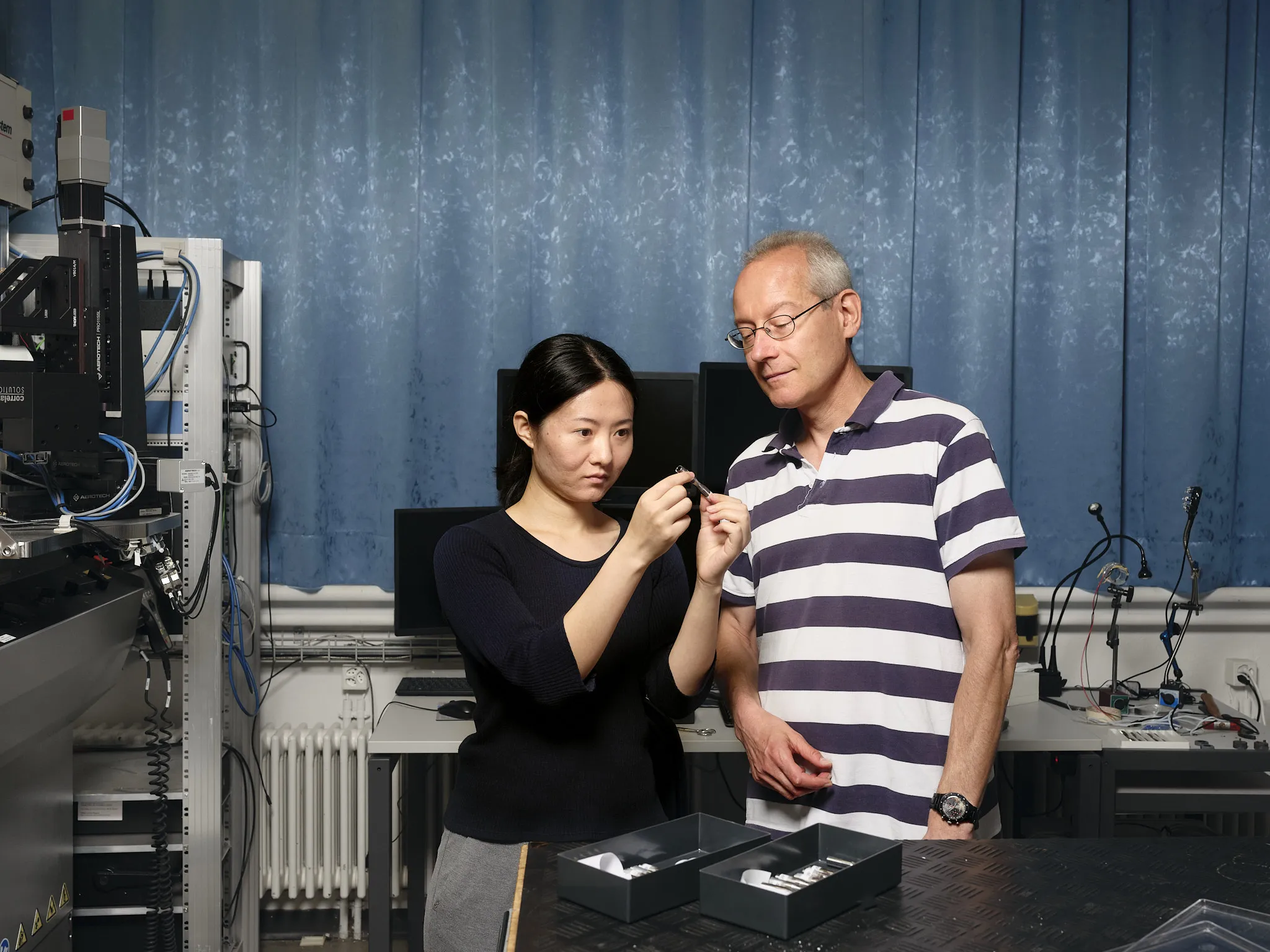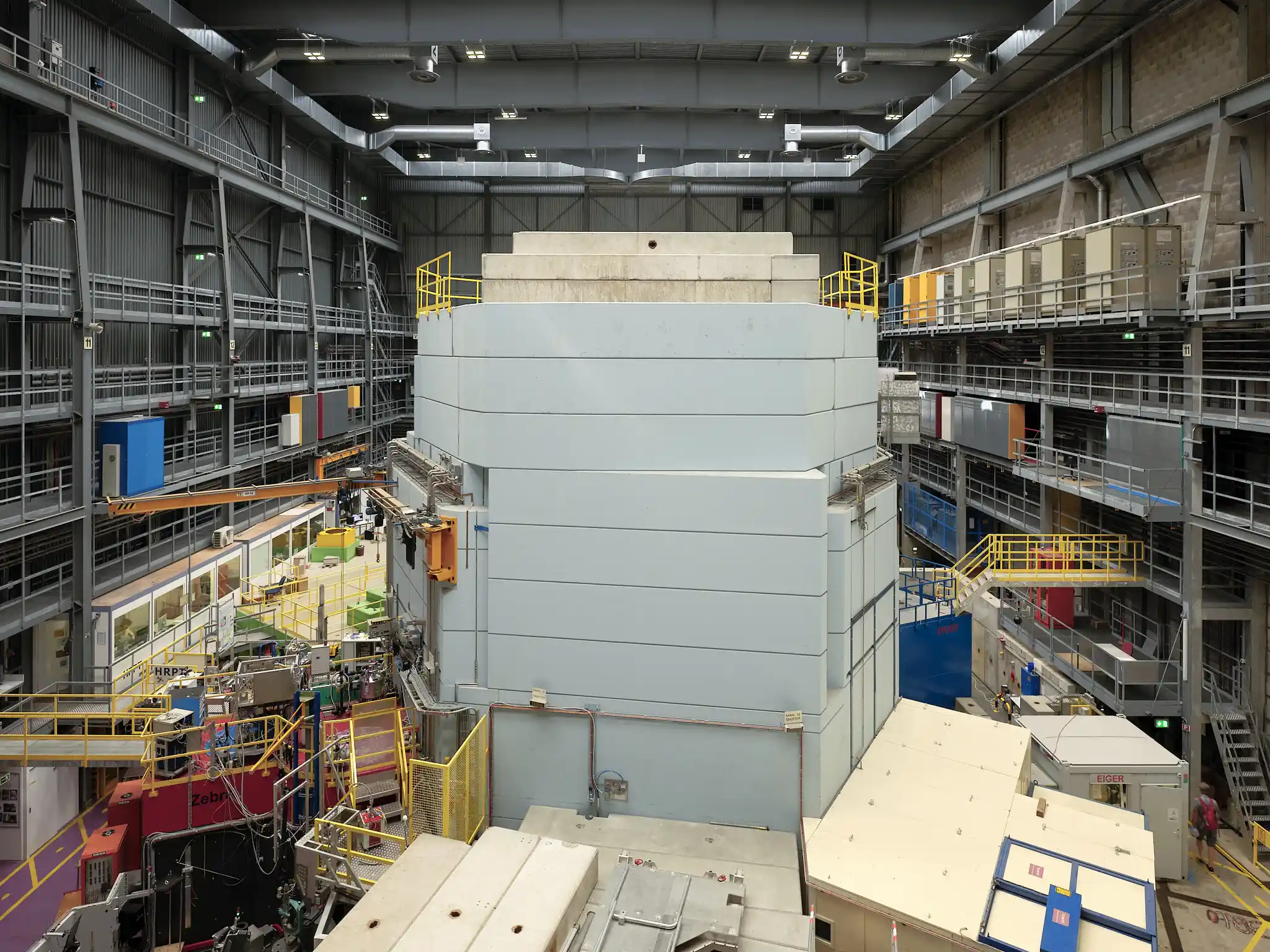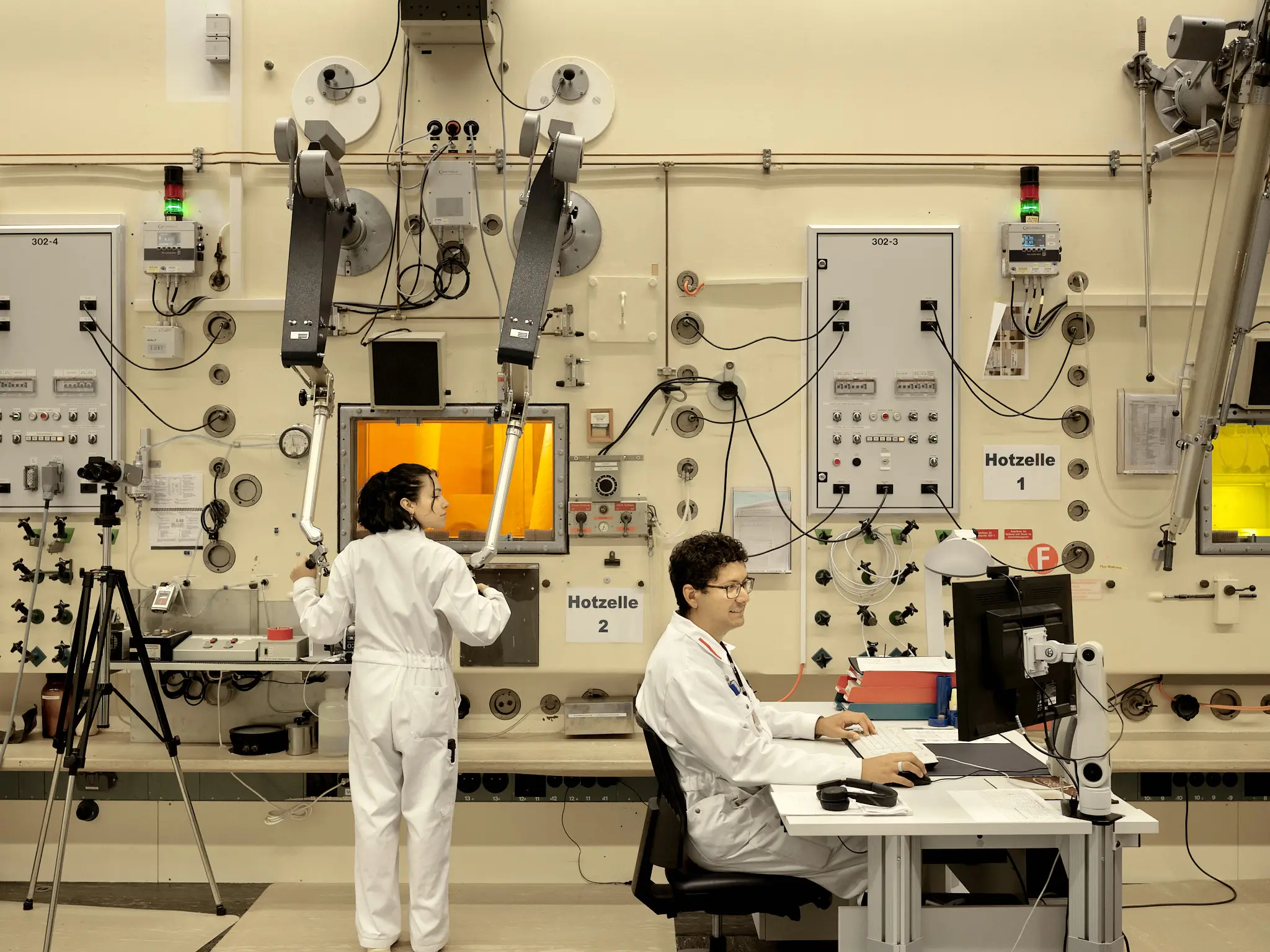


Supporting the next generation of scientists is a key priority for the operators of Swiss nuclear power plants. On their behalf, swissnuclear supports practice-oriented research projects in the fields of safety, long-term operation, and economic viability, which are conducted at recognised institutions. The results of these projects are presented at the “Research Day” organised by swissnuclear every two years.
Through a competitive selection process, swissnuclear supports several research projects at the Paul Scherrer Institute (Department of Nuclear Engineering and Sciences). The aim of these projects is to maintain expertise in nuclear technology. During the current funding period, swissnuclear is supporting five doctoral students, four postdoctoral researchers and several Master’s students.
Quick introduction?
The project involves conducting experiments at the PANDA large-scale test facility to investigate safety-relevant thermohydraulic phenomena in boiling water reactor and pressurised water reactor containments. The research focuses on the influence of sparger design and non-condensable gases in the suppression pool of a boiling water reactor, as well as natural circulation and hydrogen distribution in pressurised water reactor containments. The results augment existing databases, support international programmes (OECD/NEA PANDA-2) and contribute to the safe operation of Swiss nuclear power plants.
The project is developing a selective sorbent for the efficient removal of the long-lived radionuclide ⁶⁰Co from wastewater at nuclear power plants. The research focuses on the hydrothermal synthesis and application of the promising material MgNa₃H(PO₄)₂, which exhibits high selectivity and sorption capacity for ⁶⁰Co. The project is a continuation of the CoDAMP project from the 2024–2025 funding period.
The study investigates the thermal effects of CRUD deposits on Zircaloy cladding tubes in boiling water reactors. By combining detailed experimental CRUD characterisation with advanced Lattice Boltzmann modeling, the influence of microstructure, composition and formation stage on local heat transfer is analysed. The goal is to develop a heat transfer simulation model to analyse the thermal effects of CRUD on Zircaloy cladding tubes in a boiling water reactor. This project is a continuation of the RESCUE project from the 2024–2025 funding period.
This project focuses on the influence of hydrogen and hydrides on the temperature-dependent creep behavior in fuel cladding tubes under reactor and storage conditions. Experimental creep tests and modern characterisation methods will be used to gain a better understanding of the material behaviour. This project is a continuation of the HyCronus project from the 2024–2025 funding period.
The MAI project is augmenting the MELCOR system code with AI and machine learning methods to enable more efficient and accurate simulation of severe accidents. The research focuses on improved condensation models, accelerated calculations and uncertainty and sensitivity analyses. Building on an ongoing dissertation, ANN-based models are being developed, validated, and coupled with MELCOR to sustainably improve the code’s predictive capability and applicability. This project is a continuation of the MAI project from the 2024–2025 funding period.
The ModWRS-III project investigates welding residual stresses in safety-critical nuclear power plant components using optimised 3D finite element simulations. Building on previous projects, the analysis will focus in particular on repair welds and the influence of microstructural transformations on residual stresses. The goal is to improve the predictability of welding residual stress (WRS) in order to support the assessment of ageing-related mechanisms in the long-term operation of Swiss nuclear power plants. The project is a continuation of the ModWRS-II project from the 2024–2025 funding period.
The project is developing a coupled simulation concept for boiling flows in fuel assemblies, combining Eulerian methods, the Interface Tracking Method (ITM) and the Lattice Boltzmann Method (LBM). The goal is to perform high-resolution simulations of local transient boiling phenomena while simultaneously modeling the global flow conditions of the entire fuel assembly. In addition, the further development of the ITM code T-Flows significantly improves the modeling accuracy of phase boundaries and heat transfer processes. The project is a continuation of the BRAVA project from the 2024–2025 period.
The project expands on ongoing work to determine source terms, dose, and decay heat for spent fuel assemblies over very short decay times. Building on previous projects, the project will develop validation studies and sensitivity analyses as well as new modeling, surrogate and AI approaches to enable the rapid and robust decay heat calculations. The goal is to improve the quantification of uncertainties and to provide sound support for safety-related analyses. The project is a continuation of the swissneutronics project from the 2024–2025 funding period.
As part of the project, an interactive, visual tool based on Bayesian networks is being developed to enable better modelling and analysis of uncertainties in Level 2 PSA. The goal is to transparently assess the impact of uncertainties, as well as accident and emergency strategies, on the risk of major accidents.
Quick introduction?
The project investigates the irradiation behavior of chromium-coated, accident-tolerant zirconium cladding tubes for light-water reactors. The research focuses on the Cr-Zr interface and the oxidised surface layer, which are analysed using modern microscopic techniques. The goal is to evaluate structural stability under neutron irradiation in order to support future strategies for the industrial application of chromium-coated ATF cladding tubes.
BRAVA develops and validates CFD models for simulating boiling flow in fuel assemblies from Swiss nuclear power plants. By combining detailed (ITM, LBM) and large-scale (Eulerian) methods, and by incorporating a population balance model and machine learning, the goal is to realistically simulate and reliably evaluate both complete fuel assemblies and locally high-resolution regions.
This project aims to develop a selective sorbent for the efficient removal of the long-lived radionuclide ⁶⁰Co from wastewater at nuclear power plants. The research focuses on the hydrothermal synthesis and application of the promising material MgNa₃H(PO₄)₂ with high selectivity and sorption capacity for ⁶⁰Co.
This project focuses on the influence of hydrogen and hydrides on the temperature-dependent creep behavior of fuel cladding tubes under reactor and storage conditions. Experimental creep tests and modern characterisation methods will be used to gain a better understanding of the material behaviour.
The project investigates the influence of hydrogen and hydrides on the mechanical behavior of irradiated fuel rod cladding tubes in the context of the storage and transport of spent fuel assemblies. The research focuses on characterising hydride distributions using EBSD and neutron radiography, as well as mechanical testing of C-shaped specimens.
The MAI project will augment the MELCOR system code with AI and machine learning methods to enable more efficient and accurate simulation of severe accidents. The research focuses on improved condensation models, accelerated calculations and uncertainty and sensitivity analyses. Building on an ongoing dissertation, ANN (artificial neural network)-based models are being developed, validated, and coupled with MELCOR to sustainably improve the code’s predictive capability and applicability.
Building on the work on residual stresses in welds from LNM-22-04, the practical applicability of computationally intensive 3D finite element simulations for complex welded components is being systematically investigated. The research focuses on optimising modeling strategies to reduce computational effort, as well as on a case study of repair welds. The goal is to improve the prediction of residual welding stresses to support long-term operational ageing analyses in nuclear power plants.
The project investigates the mechanisms of CRUD formation and growth at the pore-scale level in pressurised water reactors. By combining detailed experimental characterisation with coupled Lattice Boltzmann and thermodynamic models, the project identifies the chemical and thermohydraulic processes that lead to the formation and growth of CRUD. The goal is to validate conceptual CRUD models and to improve the prediction of their effects on fuel performance and reactor safety.
The swissneutronics-2 project expands on ongoing work to determine source terms, dose and decay heat for spent fuel assemblies over very short decay times. Building on previous projects, the project will develop validation studies and sensitivity analyses as well as new modeling, surrogate and AI approaches to enable the rapid and robust decay heat calculations. The goal is to improve the quantification of uncertainties and to provide sound support for safety-related analyses.
The THX4SB project widens the PANDA experiments to investigate the formation of thermal layers in suppression pools in pressurised water reactors. The research focuses on building a relevant experimental database, developing CFD models for the analysis of thermohydraulic effects, and building up expertise in Switzerland.
The project focuses on PANDA experiments on passive containment cooling systems and natural convection in water-surrounded containments (P1A4 and P1A5). The goal is to systematically expand the experimental database for SMR designs and to validate thermohydraulic calculation codes.
Each year, swissnuclear awards a PhD grant to students who wish to deepen their knowledge in the field of nuclear energy through a doctoral thesis. Since the programme’s inception, three PhD students have received funding. Applications must be submitted via the Nuclear Engineering and Sciences Department of the Paul Scherrer Institute (PSI-NES). Anyone interested is invited to contact PSI-NES directly.
The project is developing a new physics-based model for void drift and liquid film phenomena in boiling water reactor fuel assemblies. By combining experimental data and CFD simulations, the project aims to improve existing empirical approaches and integrate them into sub-channel codes in order to enhance the predictive accuracy of safety-relevant parameters and support the design and operation of nuclear power plants.
The project is developing a novel high-pressure experimental loop to investigate CRUD formation under realistic boiling water reactor and pressurised water reactor conditions. Through targeted experiments, the interaction between water chemistry and flow dynamics, including spacer and mixing vane effects, is being systematically characterised for the first time. The resulting experimental database form the basis for the development and validation of modern multiphysical CRUD and CFD models for industrial applications.
The project is developing an integrated simulation chain for molten salt reactors that couples chemical, neutronic, fuel cycle and thermohydraulic models, as well as accident analyses. The goal is to comprehensively assess a selected molten salt reactor (MSR) design with a focus on sustainability and safety, and to support industrial development through independent analyses.
This doctoral project is supported by swissnuclear and the Gösgen nuclear power plant. This PhD project is developing a new, robust method for producing medically relevant radiolanthanides such as Lu-177 and Tb-161 in a commercial nuclear power plant. Through the use of metallic intermetallic target materials, innovative manufacturing and reprocessing techniques and realistic test irradiation, the project aims to enable the production of reliable, high-purity and medically usable radiolanthanides for nuclear medicine.
swissnuclear keeps abreast of international developments in the field of seismic risk assessment in the nuclear sector through its participation in SIGMA-3. The programme is supported by a consortium of nuclear facility operators. The goal is to refine data, models and methods for assessing seismic hazard at industrial sites and critical infrastructure.
To open and browse through the PDF, click on the button. Please note that data will be transmitted to third-party providers in the process.
More informationLorem ipsum dolor sit amet, consectetur adipiscing elit. Ut elit tellus, luctus nec ullamcorper mattis, pulvinar dapibus leo.
Lorem ipsum dolor sit amet, consectetur adipiscing elit. Ut elit tellus, luctus nec ullamcorper mattis, pulvinar dapibus leo.
You are currently viewing a placeholder content from Vimeo. To access the actual content, click the button below. Please note that doing so will share data with third-party providers.
More InformationYou are currently viewing a placeholder content from YouTube. To access the actual content, click the button below. Please note that doing so will share data with third-party providers.
More InformationYou need to load content from reCAPTCHA to submit the form. Please note that doing so will share data with third-party providers.
More InformationYou are currently viewing a placeholder content from Google Maps. To access the actual content, click the button below. Please note that doing so will share data with third-party providers.
More InformationYou are currently viewing a placeholder content from Mapbox. To access the actual content, click the button below. Please note that doing so will share data with third-party providers.
More InformationYou are currently viewing a placeholder content from OpenStreetMap. To access the actual content, click the button below. Please note that doing so will share data with third-party providers.
More InformationYou are currently viewing a placeholder content from Juicer. To access the actual content, click the button below. Please note that doing so will share data with third-party providers.
More InformationTo open and browse through the PDF, click on the button. Please note that data will be transmitted to third-party providers in the process.
More Information