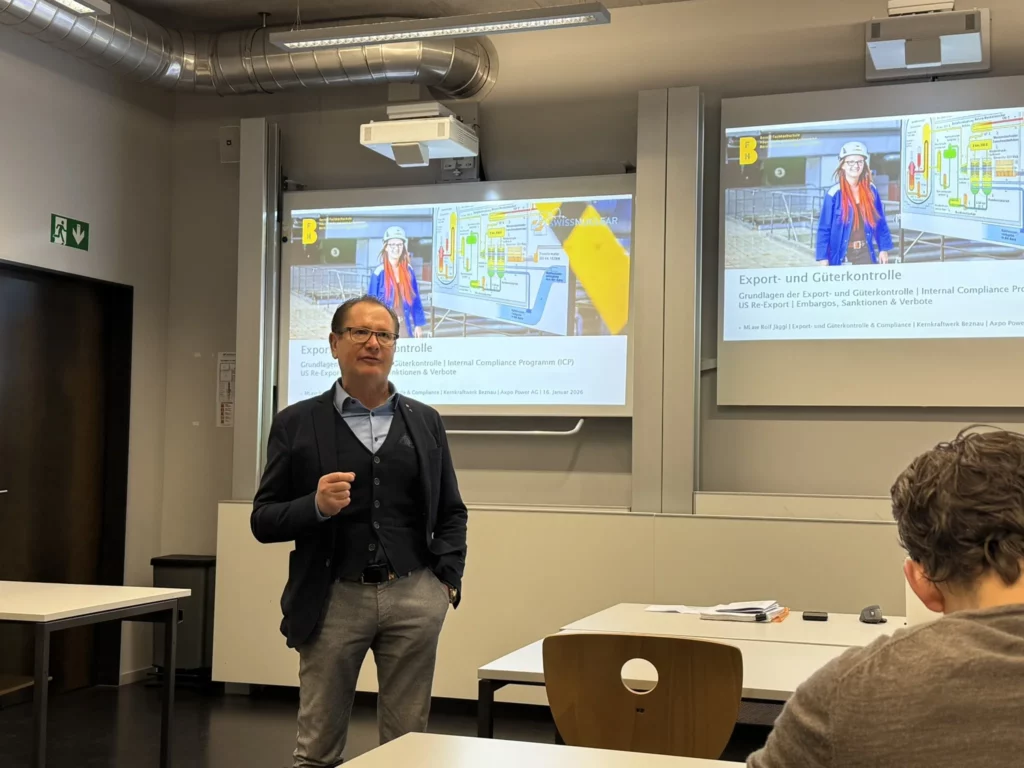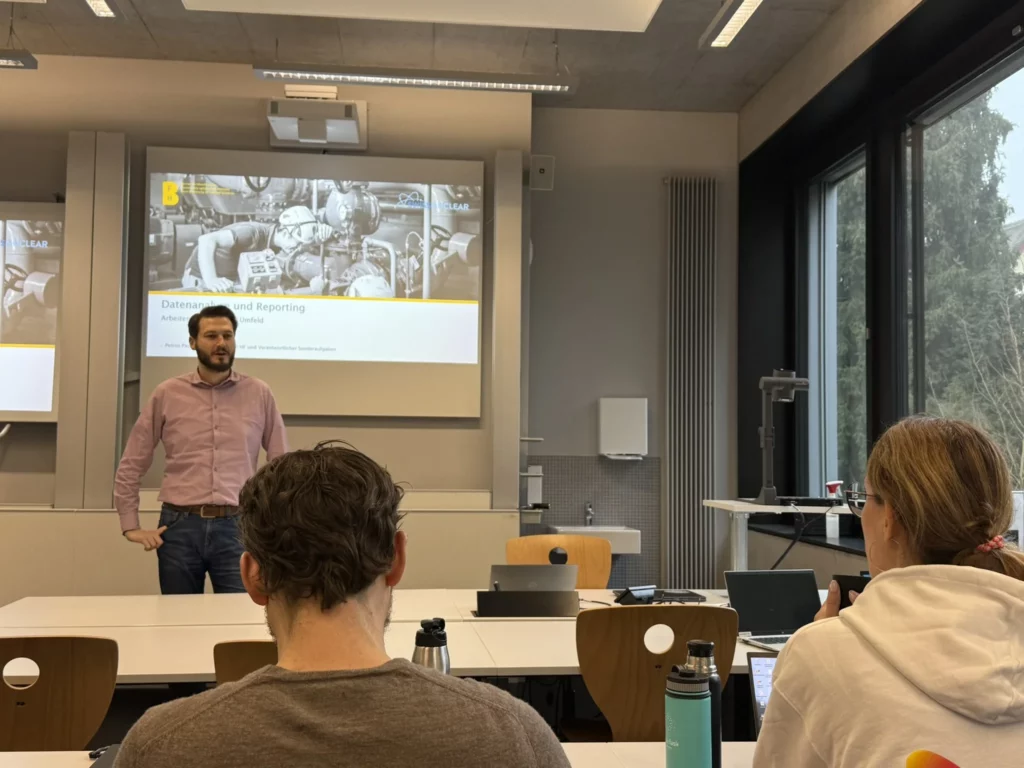
On January 16, 2026, another module of the CAS "Working Environment Nuclear Energy" took place. The focus was on export and goods control as well as data analysis and reporting in security-relevant organizations.
🔎 Export and goods control
In the morning, Rolf Jäggi (Axpo Power AG, Beznau Nuclear Power Plant) provided practical insights into export and goods control.
💡An exciting introduction showed that control mechanisms are not a modern construct. Even in ancient times and the Middle Ages, attempts were made to regulate the distribution and trade of sensitive goods.
🌍 Today's international control system is based on several multilateral export control regimes and international agreements with the aim of ensuring the responsible and coordinated handling of so-called dual-use goods. These include goods, technologies, or software that can be used in both civilian and military applications, such as machine tools or drones.
🎯 What does export control mean in concrete terms?
Export control is not a blanket ban on exports, but a structured cascade of checks comprising several steps:
– Sanctions and embargo checks
– Classification of goods (e.g., dual-use)
– Verification of end use and end recipient
– Reporting obligations under the "catch-all" rule
In the Swiss context, the legal basis ranges from the Federal Constitution to goods control law and international sanctions. Under certain conditions, foreign export control regulations may also be relevant – for example, in the case of re-exports or technology transfers.
📊 Data analysis & reporting
In the afternoon, Petros Papadopulos (Nuclear Technology School NTS, Gösgen-Däniken AG Nuclear Power Plant) provided an insight into the field of data analysis and reporting. Structured reporting processes are key here: organizations such as ENSI and WANO promote transparency and continuous improvement, and thus also the safety of plants and facilities, with clear guidelines, periodic reports, and international exchange of experience.
🤖 Outlook
Digital tools for data analysis, simulations, and digital twins open up new possibilities for identifying safety-related issues at an early stage and evaluating them in a well-founded manner.
👉 Conclusion: Export control, compliance, and international cooperation are of central importance in an internationally networked environment. 🌍
🔎 Further information about CAS:
CAS Working Environment Nuclear Energy | BFH