On May 1, 2026, the program continued with the “Emergency Management” module of the CAS in “The Nuclear Energy Workplace.” The focus was on crisis and emergency management.
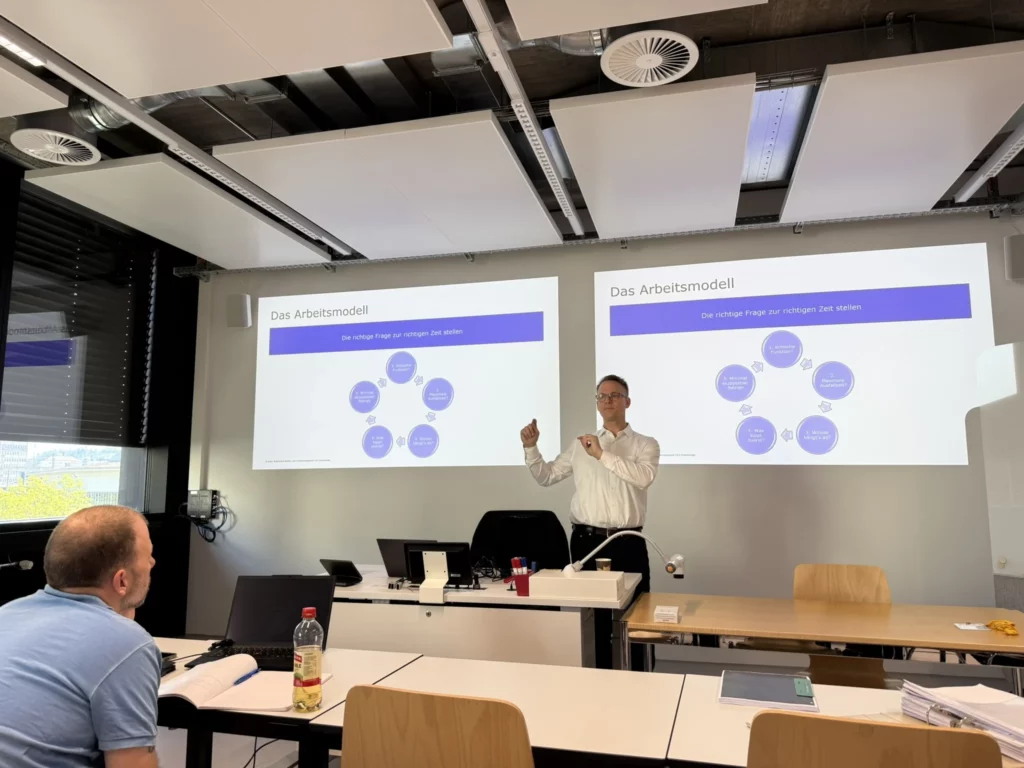
Simon Rüegger (Axpo Group) kicked off the day with a brief review, emphasizing the distinction between an emergency and a crisis:
🔹 In emergency management, an incident is actively managed.
🔹 Crisis management involves navigating uncertainty and incomplete information.
🔍 The first step is always to assess the situation:
🔹 What is the defining situation?
🔹What is the most dangerous trend?
🔹 What is the most likely outcome?
🧩 To manage complexity, it helps to clearly structure the problem: Major challenges are broken down into smaller, manageable subproblems that are solved step by step. Things get complicated when these subproblems are interdependent and influence one another. That is why the following applies in emergency management:
🔹 Good preparation is everything, because the first few hours are crucial.
🔹 Information must be structured and updated on an ongoing basis§.
🔹 You always have to think one step ahead.
📓 Accurate documentation is key: The on-site team keeps a log in which all events are recorded. Individual reports can be a “game changer” and fundamentally alter a situation.
Once the emergency has been stabilized, crisis management takes over.
📢 Communication plays a key role here, and the following factors are crucial:
🔹 Accessibility
🔹Honesty
🔹 Consistency ("One Voice")
🔹 Transparency
🔹 Clarity
⚛️ In the second part of the module, Marek Cernoch (Axpo Group) provided us with fascinating insights into emergency preparedness in the field of nuclear energy.
The reliability of nuclear power plants is based on the "defense in depth" approach and on the four key safety objectives:
🔹 Controlling the chain reaction
🔹 Cooling of the fuel elements
🔹 Containment of radioactive materials
🔹 Limiting the radiological impact
🎯 The goal of emergency response planning is to minimize the impact of potential incidents, prevent further incidents, and protect people and the environment.
🛡️ Emergency preparedness at a nuclear power plant includes:
🔹 Planning and Organization
🔹 Technical safeguards
🔹 Education and regular training
🔹 Alerts and Information
🔹 Radiation protection
🔹 Collaboration and Communication
🔹 Continuous improvement (excellence as the benchmark)
At Swiss nuclear power plants, every position is staffed by multiple personnel, and the facilities are monitored at all times by highly qualified staff.
⚖️ Regulatory frameworks underscore the critical importance of effective emergency preparedness.
💡 Emergency and crisis management begin long before an incident occurs. Key to this are thorough preparation, clear structures, and the ability to deal effectively with uncertainty. Proactive communication is essential in this regard.
🔎 Further information about CAS:
CAS Working Environment Nuclear Energy | BFH